On-page SEO tips for ecommerce businesses
 SEO has two sides to it: on-page optimization and off-page optimization. On-page is about improving your page content to help it rank in search results. Off-page optimization is about building trust e.g. when other sites link to you, it tells Google that other people are vouching for your content, which plays a role in how your pages rank.
- On-page SEO means optimizing the content and HTML of each individual page so search engines understand what it is about and rank it for the right searches.
- The highest-impact elements are your title tag, meta description, H1 heading, and the first 100 words of your page copy — get these right before anything else.
- Every product and category page should target one primary keyword and a handful of related terms, woven naturally into the copy rather than stuffed in.
- Images, internal links, and page speed all count — small technical improvements stack up significantly over time.
This blog gives focuses on on-page SEO tactics for ecommerce stores. These optimizations will also help your store and products get recommended by AI models via tools like ChatGPT, Gemini, and others.
In this guide, we use “floral skirts” as our sample keyword and outline some things you should be thinking about to improve your search rankings.
What is on-page SEO?
On-page SEO is the set of things you do to help search engines understand what your page is about and its purpose. Search engines use the content on your page to decide whether or not it's relevant to show based on what customers are searching for.
Example: Let's optimize a page for the keyword "floral skirts"
Someone searching for 'floral skirts' likely wants to shop for skirts with floral patterns. So Google examines all the pages on the web to determine which ones are most suitable to display to the user.
Here is what Google looks at:
Title tag: this is the title that shows at the top of your browser tab. This tells Google what the page is about.
Meta description: this is a 1-2 sentence description of what the page is about. This provides Google with more information about the page content.
Headings (H1, H2, H3): These are HTML tags. H1 is the main page heading, H2 is one one-level-down down sub-heading, and H3 is another level lower. These headings tell Google about the structure of your content. H1 headings inform Google about the primary topic of the page.
URL
Body copy: your text content underneath each heading.
Images: file names and alt text of your images, for example, red-floral-skirt.jpg
Internal links: links on your site that point to other pages on your site
Next, we’ll show you how to use your keyword in all the places that we mention here: title tags, headings, etc.
Start with the basics: Optimize your URL, title, meta description, and H1
These are the first things search engines and shoppers see. Keep them short and clear. Mention your main keyword early.
Element | What it is | Best practice | Example for “floral skirts” |
|---|---|---|---|
URL | Short, readable, includes keyword | www.yourdomain.com/floral-skirts/ | |
Title tag | Heading in search results | Include keyword & add one benefit or detail to drive clicks. ~50–60 chars | Floral Skirts: Stylish picks in soft cotton, rayon & linen |
Meta description | Short summary under the title | Use keyword, benefits, size/fit or shipping info, ~140–160 chars | Explore floral skirts in midi and mini cuts. Easy returns, fast shipping, and sizes XS–XL. Find your new favorite print. |
H1 | Main page heading | One H1 heading per page, match search intent | Floral Skirts |
If you're using Shopify or similar platform, when you change a URL, the old URL automatically redirects to your new URL so it won't break any old links that link to the page.
Optimize your product images for SEO
Images don't just sell the product, they also impact your search results. Here is what you need to do to optimize your images for search engines. These also help your images rank in Google's image search (example here - the image tab)
File names: Use clear names, not “IMG_1234.jpg.” Example: midi-floral-skirt-blue-daisy.jpg
Alt text: This is the text you see when you hover over an image on the web. It's a few words to describe the image. Example: Women’s midi floral skirt with blue daisy print
Size: Keep images under 200–300 KB when possible. Use common image formats like JPG, PNG or WebP. Pages that load faster are prioritized by Google because they want users to have a good experience when they click on search results.
Multiple photos: More photos are better for customers but also tell Google that your page has rich content.
Optimize your product descriptions
If you're trying to rank a specific product page, use the same concepts in your product descriptions - the name of the product should contain the keyword, the descriptions should include keywords, etc.
Internal links that make sense
Internal links are links between your own pages. They help shoppers move around and help search engines see what matters. Link to your target page from other pages on your site. Here are some examples:
If you write a blog post about spring outfit ideas, link to your floral skirts page with text like “shop floral skirts” or "cotton floral skirts".
On your homepage, you could have a product widget linking to the page.
Your category page link could be on the site header. This tells Google it's important enough to link from all pages of your site.
Keep links useful. Don't overdo it. These links tell Google that the page is important.
Create a simple FAQ section
FAQs help customers and can help your page in search results. This is good content to go at the bottom of your category page or have a separate page for it and link to it from the floral skirts page or in the product detail pages.
Sample FAQs for “floral skirts”
How do I choose the right skirt length for me? Check your height and where you want the hem to fall. Midi skirts usually hit mid‑calf.
What tops go with floral skirts? Solid tees, denim jackets, linen shirts, and simple sweaters all work.
Are your floral skirts lined? Many are lined. Look for “lined” in the product details.
How do I wash printed skirts? Cold wash, gentle cycle, and line dry to protect the print.
Local SEO tip (if you have a store)
If you have a physical shop, add a short block on the page that mentions your city and pickup options. Example: “If you're in the Austin area, you can pickup at our store”. This can help you show up for local search keywords like "floral skirts Austin"
Look at who you're competing against.
Google shows different results to each of us. Here are two sites that came up for me. Do a search yourself and explore the pages that rank on page 1. These are the sites you're competing with.
Sample 1:
Top of page copy:
In my opinion, the number of times this site uses 'Floral' in the top section here is a bit spammy. But conceptually, this is what you need: tell Google what your page is about while keeping it useful for your audience.
It could be simpler like "Our floral skirts are light, easy to style, and made for everyday wear. Discover mini and midi cuts, soft fabrics, and a variety of styles featuring floral prints that are perfect for both work and weekends."
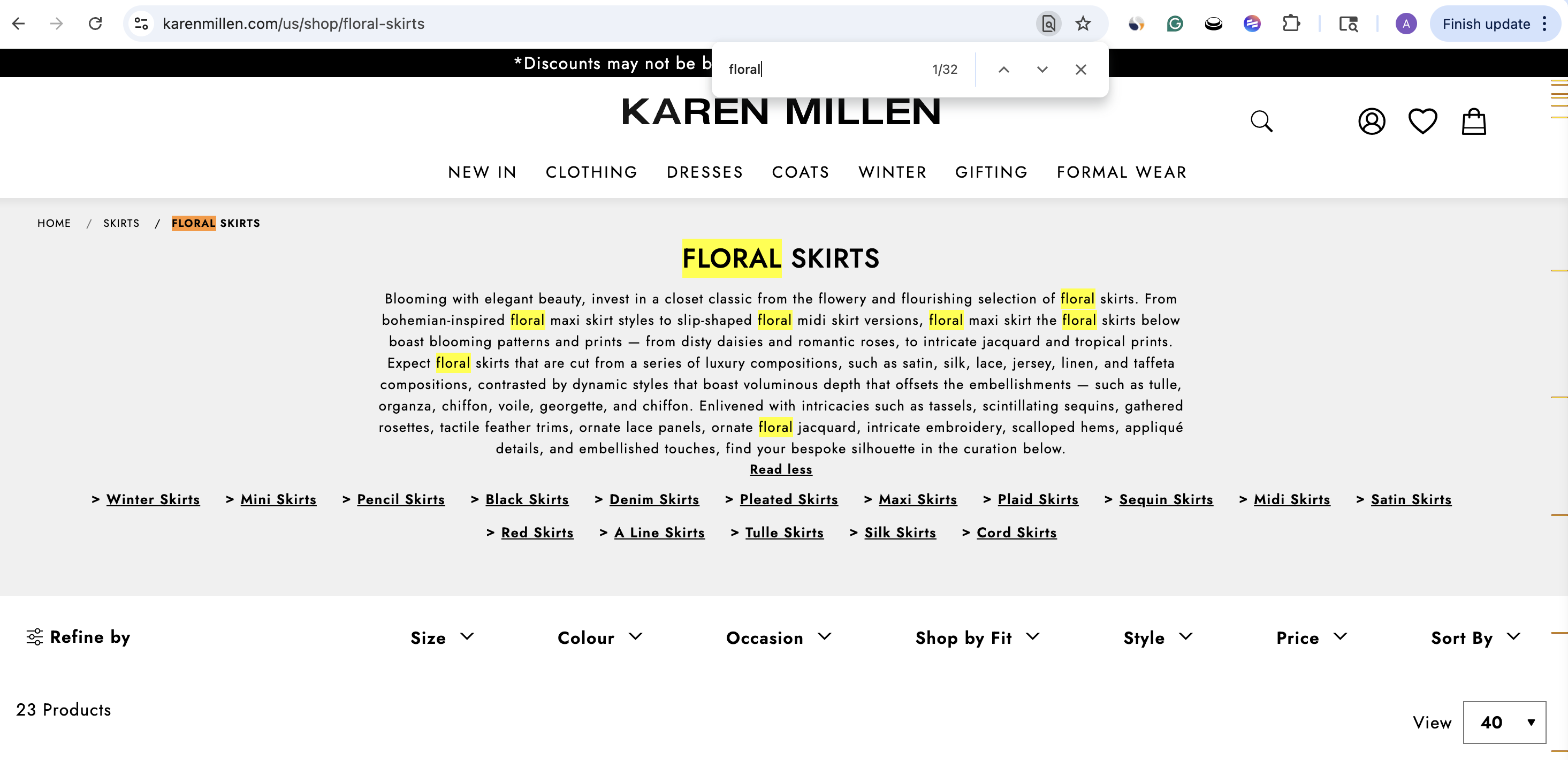 I found very few sites that have copy on top of category pages so this can give you an advantage if you use it well. One sentence summarizing what your collection is about would improve the user experience by giving users context as they browse through your collection.
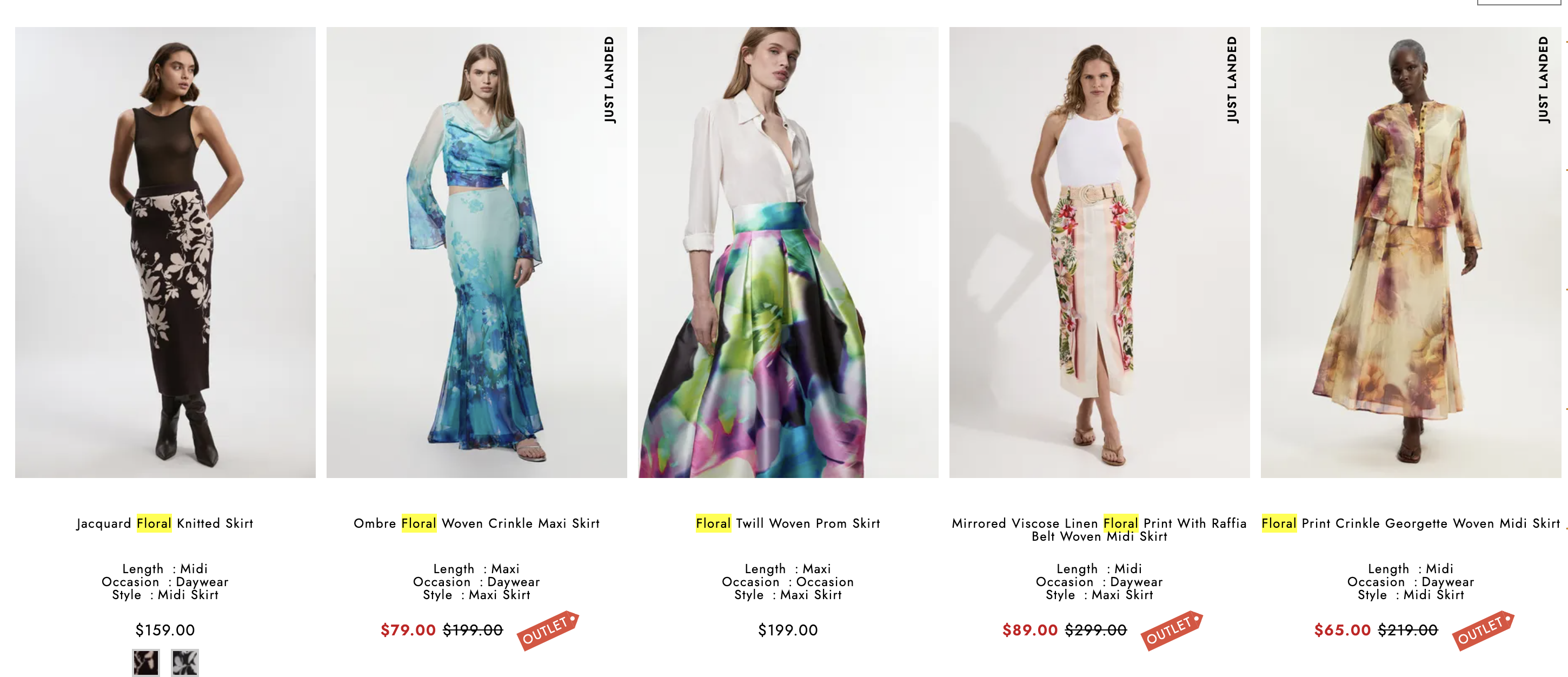
Product listing titles:
Next, most product listings on the page have the word Floral and Skirt in it. Keep it natural and don't force it into every product.
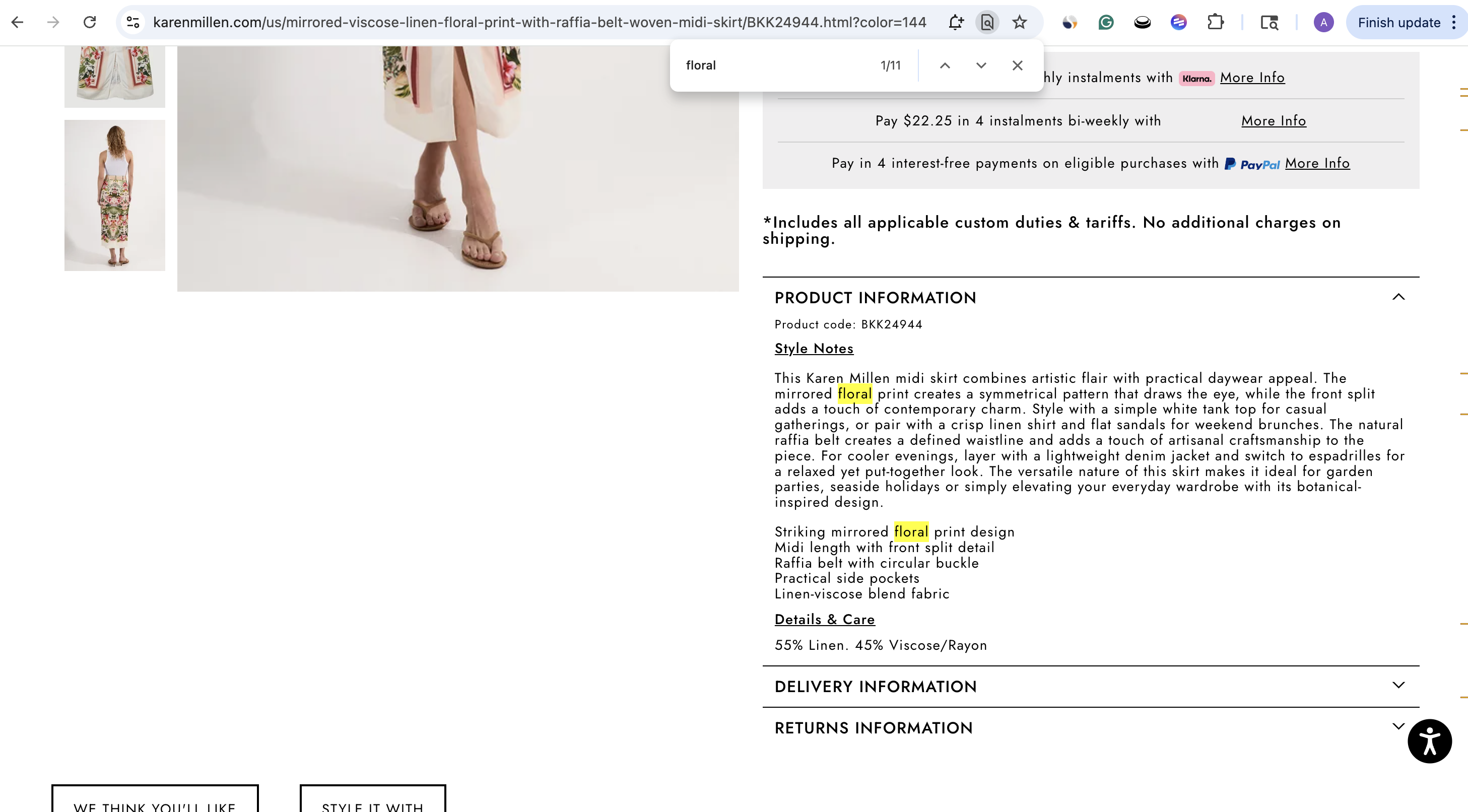
Product detail page:
Here is a sample of one of their product pages. Again, here they are optimizing this page for a specific style and fabric. Notice the url below as well.
Sample 2:
This site doesn't have much copy at the top but the bottom of the site has a blurb on floral skirts and links to several different product lines in floral categories.
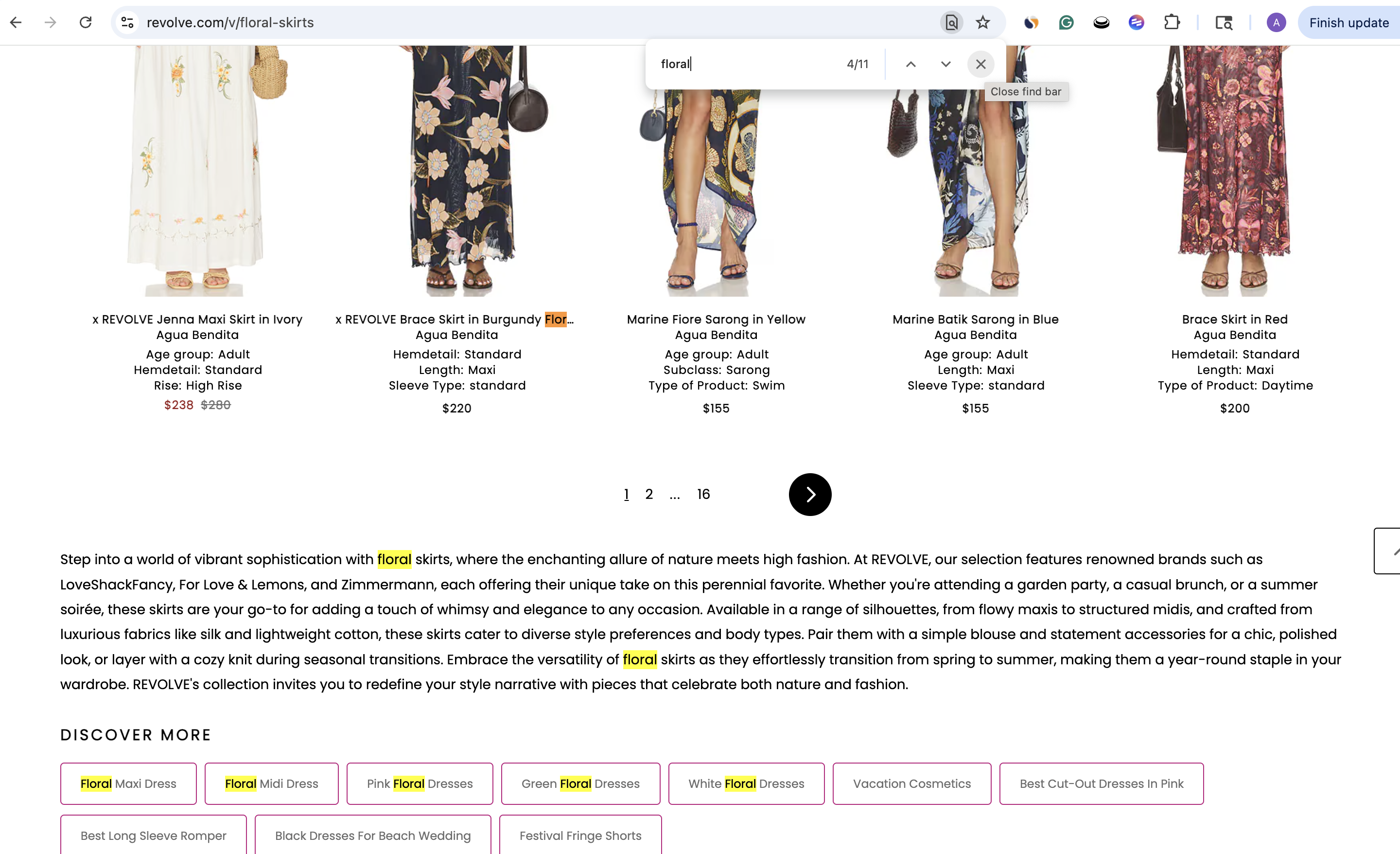
Here is a sample of one of their product pafes
Summary on-page optimization checklist
Many of these don't take too long to do. Plan to optimize a few pages a month and see the results. For a structured routine, try our 5-hour per week SEO plan.
Target one main keyword per page (here: “floral skirts”).
Clear URL: /floral-skirts/
Title tag includes keyword and value.
Meta description with benefits.
Only one H1 tag on the page. Use subheadings for extra info.
On category pages, include short, helpful intro copy above or below the product grid.
Use keywords in product titles
Smallish file sizes on images with descriptive alt text. e.g. newer phones takes images at 5-6MB each. Crop and remove backgrounds to reduce the file size to under 1MB. If you're using a platform like Shopify, they might automatically optimize images for you.
Internal links to and from related pages.
FAQ section for common questions.
Finally, track what’s working
Review your results every week in Google Search Console (if you haven't set this up yet, you should - this is Google's free SEO tool).
Look for:
Search terms: Are you getting impressions for “floral skirts” and related phrases? Is this number increasing after you made improvements to your pages
Clicks: How many clicks are those impressions getting. Did clicks increase after you optimized your page with headings, etc.
Search result ranking improvements can take a few weeks after you make changes so be patient and keep optimizing. You'll start to see results for some pages faster than others.
The best benefit of SEO is that it's ongoing traffic for no cost. Blogging is another powerful way to boost your SEO. So start optimizing one page at a time. Good luck!